TCS
Accelerating Drug Discovery through AI
Category
Real Estate and Housing Services
B2C
Tools
Figma
Team
AI Scientists, Pharma SMEs, Strategy Consultants, Business Stakeholders
Timeline
2024
Contribution
UI/UX Design, Prototyping, Design Toolkit
Introduction
Over 90% of drug candidates fail during development, often due to late-stage issues that weren’t caught early on. While traditional methods rely on screening known molecules, they explore only a tiny fraction of the vast chemical space. Existing tools optimize one property at a time, leaving gaps that lead to costly failures. Recognizing this challenge, AI presents a powerful opportunity to design novel molecules with multiple optimized properties from the start.
Project
This project explores
Problems
Drug discovery is a multi-step process where different properties of drug molecules are optimized sequentially, which often leads to a high attrition rate. Scientists have to test thousands of existing compounds through a trial-and-error approach, and most of them fail — especially in the later stages like clinical trials. Also, traditional methods only explore a small part of the vast chemical space, which means many potentially better drug options are never even considered.
Pain points
Attrition in discovery
Over 85% of promising compounds fail to move beyond hit-to-lead. Pharma teams don’t fully trust in-silico models without strong experimental backing.
IP and collaboration roadblocks
Negotiating IP clauses and terms of engagement is slow and tedious. Cross-industry collaboration often collapses at the contract stage.
Clinical trials lack recognition
FDA and other global regulators often don’t accept Indian clinical trial data, leading to repetition and delays.
Insufficient R&D budgets
Mid-sized pharma companies struggle to fund advanced research, especially in AI-driven molecular design.
Tools are outdated or fragmented
Medicinal chemists still rely on legacy tools like Reaxys or SciFinder. Advanced synthesis route prediction and off-target effects analysis are siloed or underdeveloped.
Goals
Discover the unmet needs across various stages of drug discovery Explore pharma's openness to partnering with AI providers Understand procurement and IP ownership concerns Map industry-specific challenges in India and globally Identify target personas and decision-makers in pharma R&D
Discover the unmet needs across various stages of drug discovery
Explore pharma's openness to partnering with AI providers
Understand procurement and IP ownership concerns
Map industry-specific challenges in India and globally
Identify target personas and decision-makers in pharma R&D
Impact
De novo drug design is an advanced approach where AI generates entirely new molecular structures from scratch, rather than modifying existing ones. These molecules are designed to target specific biological mechanisms, improving the chances of success. AI plays a critical role in the early stages of drug discovery—particularly during the in silico(computer-based) phase—by helping guide and refine in vitro (lab-based) experiments. Recognizing the potential of AI to accelerate this process, TCS has developed predictive models that support faster, data-driven decisions in identifying promising drug candidates, ultimately reducing both time and cost across the drug discovery pipeline.
Process &
Context
AI in drug discovery is promising — but adoption depends on trust, usability, and alignment with pharma goals.
We interviewed 30+ pharma stakeholders including R&D scientists, CRO leads, startup founders, and biotech strategists to understand their motivations, blockers, and expectations from AI in small molecule discovery. While the interest in AI is high, true adoption will depend on building trust, reducing risk, and creating clear paths to ROI.
Major issues
Hard to trust black-box AI
Scientists won’t use tools they can’t explain.
They need transparent results that match their thinking.
Failures happen too late
Teams spend months chasing weak molecules.
AI needs to step in earlier — during hit-to-lead.
CROs want low-risk entry
They're open to AI but want results first.
Flexible models like pilots or milestone payments work best.
Data exists, but is underused
Especially for cancer and rare disease.
AI can unlock value from past trials via repurposing.
India lacks lab infra
Good people, limited places to test.
A full-stack solution (AI + synthesis planning) is needed.
Oncology drives investment
AMR matters, but funding goes to cancer.
AI tools should align with market priorities.
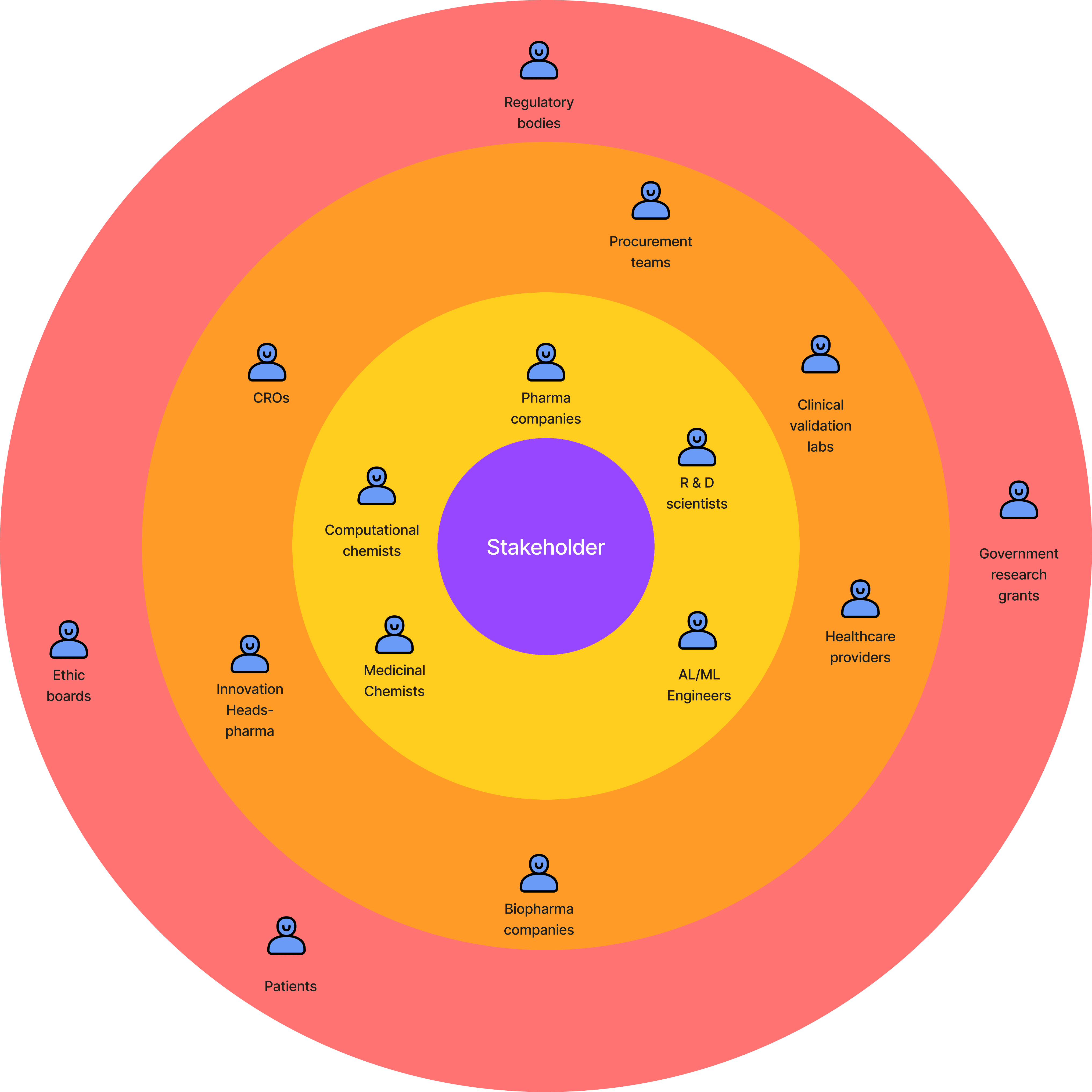
Stakeholder mapping
Competitor
Analysis
Key Insights from Competitor Analysis:
Across successful apps, gamification works best when users can visualise progress, receive instant rewards, and feel part of a recurring loop. Apps like CRED and Starbucks build loyalty through tiered rewards and progress tracking, while Snapchat and gaming apps sustain daily engagement through streaks and collectibles. These insights helped shape the Pay on Credit milestone journey, focusing on visible progress, achievable rewards, and consistent motivation.
User Flow
Starting from the POC payment page to the next payment nudge.
Concept & Style guide
Screens
These screens illustrate the step-by-step gamified payment journey within the app. Users are guided from the moment they tap the gamification banner to completing payments and collecting rewards. Each step highlights progress, engagement, and milestones, showing how transactions are turned into an interactive, rewarding experience.